Why Businesses Need Enterprise Content Management Services
- quadrantit4
- Aug 28, 2025
- 4 min read

In today’s digital-first world, businesses are generating more information than ever before. From invoices and contracts to emails, HR records, multimedia files, and customer data, the volume of content continues to grow at an unprecedented pace. Without the right systems in place, this information overload can lead to inefficiencies, compliance risks, and lost opportunities. That’s where Enterprise Content Management Services (ECM Services) step in.
What Are Enterprise Content Management Services?
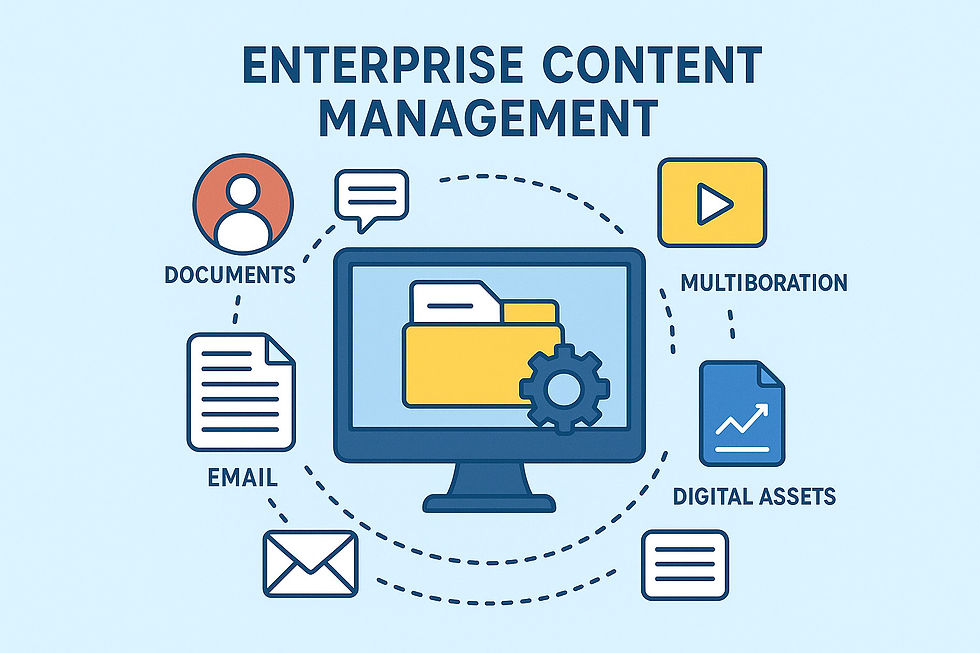
Enterprise Content Management Services refer to a set of processes, tools, and strategies that allow organizations to handle unstructured information — such as documents, emails, images, and videos — in a secure, centralized, and structured way.
Unlike traditional document storage or file-sharing platforms that simply hold files, ECM services cover the entire lifecycle of content — from creation and editing to storage, retrieval, archival, and disposal. This ensures that the right people can access the right information at the right time, on any device, regardless of location.
Key Components of Enterprise Content Management Services
An effective ECM system consists of several core components:
1. Document Management
Organize, track, and manage files efficiently with features like version control, advanced search, and access permissions. This reduces duplication and ensures employees always work with the latest version of a document.
2. Content Capture
ECM services digitize physical documents using scanning and OCR (Optical Character Recognition). Once indexed, these files become fully searchable and easily retrievable.
3. Workflow Automation
Manual approval processes are time-consuming. With ECM, workflows such as invoice approvals, contract renewals, or HR onboarding can be automated, ensuring smoother operations.
4. Records Management
Every organization must comply with retention policies and regulatory standards. ECM services apply retention schedules and ensure documents are archived or disposed of securely.
5. Collaboration Tools
Modern ECM platforms include co-authoring capabilities, real-time sharing, and commenting features, allowing teams to collaborate more effectively.
6. Security & Compliance
ECM systems restrict access to sensitive documents, log activity for auditing, and help businesses meet compliance requirements like HIPAA, GDPR, and SOX.
7. Integration Support
Integration with existing tools such as ERP, CRM, Microsoft 365, Google Workspace, or SAP ensures smooth connectivity across business systems.
8. Flexible Deployment
Depending on business needs, ECM services can be deployed on-premises, in the cloud, or in hybrid models. Cloud-based options are increasingly popular due to scalability and remote accessibility.
How Enterprise Content Management Services Work
The working model of ECM follows a structured process:
Capture — Documents are collected from emails, scanners, mobile uploads, or system imports and converted into usable formats.
Store & Organize — Files are indexed using metadata like author, date, and department, making them easy to find.
Manage Access — Permissions ensure only authorized users can view or edit sensitive files.
Automate Processes — Workflows route documents for approval or review, eliminating delays.
Archive & Retain — Inactive documents are archived based on compliance rules.
Retrieve & Audit — Advanced search tools enable quick document retrieval, and all activities are logged for transparency.
Benefits of Enterprise Content Management Services
Investing in ECM services provides a wide range of advantages across industries and departments.
1. Improved Efficiency & Productivity
Employees waste less time searching for documents or chasing approvals. Automation reduces bottlenecks, speeding up business operations.
2. Cost Savings
By minimizing paper use, physical storage, and manual administrative work, ECM cuts costs significantly. Cloud ECM further reduces infrastructure expenses.
3. Enhanced Collaboration
Teams can work together on the same documents in real time, add comments, and track edits — boosting project turnaround and teamwork.
4. Compliance & Risk Management
With features like audit trails, encryption, and access control, ECM ensures compliance with industry regulations while reducing risks of breaches and lost documents.
5. Remote Access & Mobility
Cloud-based ECM solutions support remote teams by providing secure access from anywhere, on any device — ideal for hybrid workplaces.
6. Better Customer Experience
Quick access to accurate client data allows customer-facing teams to deliver faster and more reliable service.
Real-World Use Cases of ECM Services
ECM services are not limited to a single industry. Here are some examples of their practical applications:
Finance: Automating invoice approvals, expense management, and audit preparation.
Human Resources: Managing resumes, onboarding paperwork, performance reviews, and compliance forms.
Healthcare: Digitizing patient records, prescriptions, and lab reports while ensuring HIPAA compliance.
Legal & Contracts: Storing case files, legal agreements, and contracts with version control and secure access.
Manufacturing: Managing technical manuals, certifications, and supply chain documents.
ECM vs. Traditional Document Management
Traditional document management focuses primarily on storing and retrieving files. While this is helpful, it doesn’t address workflow, compliance, or automation.
Document Management = Store + Retrieve ECM Services = Store + Retrieve + Automate + Analyze + Govern
By going beyond storage, ECM aligns content with business objectives, supporting digital transformation strategies.
Why Enterprise Content Management Services Matter
In today’s data-driven environment, businesses rely heavily on information for decision-making and growth. Without a robust content management system, organizations risk inefficiency, compliance issues, and lost opportunities.
Enterprise Content Management Services provide the foundation for managing content securely, efficiently, and intelligently. From HR and finance to healthcare and manufacturing, ECM simplifies workflows, strengthens compliance, enhances collaboration, and protects sensitive information.
In short, ECM services transform unstructured data into a valuable business asset. By investing in the right solution, organizations not only streamline operations but also future-proof themselves against the ever-growing challenges of content management in the digital age.


Comments